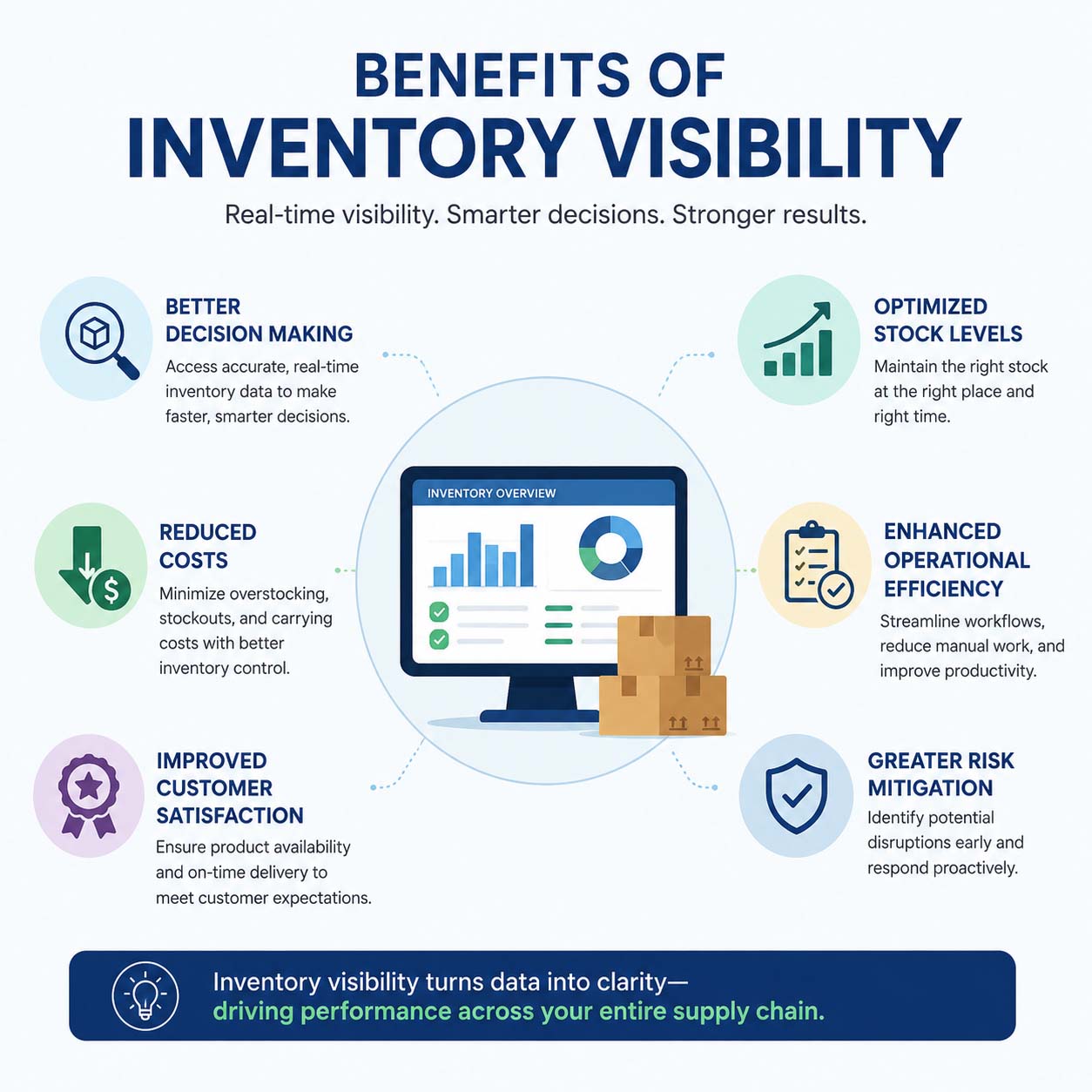
Benefits of Inventory Visibility: Why Real-Time Stock Tracking Drives Better Business Decisions
Understanding the benefits of inventory visibility helps businesses avoid costly mistakes, improve customer satisfaction, and make smarter purchasing decisions. Whether you manage a retail store, warehouse, manufacturing company, or e-commerce business, knowing where inventory is, how much is available, and when it needs replenishment can improve everyday operations.
This guide explains inventory visibility, its key benefits, how real-time stock information supports business decisions, and practical ways to improve inventory visibility.
What Is Inventory Visibility?
Inventory visibility is the ability to see accurate, up-to-date information about stock across different locations, warehouses, sales channels, and stages of the supply chain.
Instead of relying entirely on disconnected spreadsheets or manual stock counts, businesses can use inventory management systems to track product quantities, locations, incoming shipments, outgoing orders, and available stock.
Good visibility allows managers to answer important questions such as:
- How many units are available?
- Where is each product stored?
- Which items are selling fastest?
- Which products need replenishment?
- Which shipments are currently in transit?
As a result, employees and managers can make decisions using more current inventory information rather than estimates.
Key Benefits of Inventory Visibility for Businesses
The benefits of inventory visibility extend beyond knowing how much stock is available. Better information can improve warehouse operations, purchasing, customer service, financial planning, and supply chain management.
Better Inventory Accuracy
One major advantage is having more reliable stock information.
When system records closely match physical inventory, employees spend less time searching for missing products or correcting inaccurate records.
Companies using inventory valuation methods such as What Is FIFO can also maintain a more structured approach to how stock moves through the business.
Faster Order Fulfillment
Customers generally expect businesses to provide accurate availability information and timely delivery.
Real-time stock tracking can help warehouse teams locate available products and determine where an order should be fulfilled.
Furthermore, accurate stock information reduces the risk of accepting orders for products that are unavailable.
Lower Inventory Costs
Excess inventory can tie up working capital and increase storage expenses. However, carrying too little stock can create shortages and missed sales.
Better visibility helps companies identify slow-moving products, monitor demand, and make more informed replenishment decisions.
Consequently, businesses can work toward healthier inventory levels instead of routinely overstocking products.
Improved Customer Experience
Customers want to know whether products are actually available.
When inventory information is updated across sales channels, websites and sales teams can provide more reliable availability and delivery information.
As a result, customers are less likely to encounter unexpected cancellations or delays caused by inaccurate stock records.
Better Business Decisions
Managers need accurate information when deciding what to purchase, where inventory should be located, and which products require attention.
Instead of relying mainly on estimates, inventory data can support purchasing, pricing, replenishment, and production decisions.
Why Inventory Visibility Matters Across the Supply Chain
Inventory rarely remains in one location.
Products and materials can move between suppliers, manufacturing facilities, warehouses, distribution centers, retail stores, transportation networks, and customers.
Without sufficient visibility, businesses may struggle to understand where stock is located or whether enough inventory is available to meet demand.
Inventory visibility can help organizations:
- Monitor incoming shipments
- Identify potential delays
- Reduce stock shortages
- Coordinate warehouse operations
- Improve demand planning
- Respond more quickly to disruptions
For businesses with several warehouses or sales channels, having a centralized view becomes particularly useful.
Microsoft explains that its Inventory Visibility service can centrally track inventory status across multiple data sources, warehouses, and locations while supporting real-time availability and shortage queries. Its documentation provides a useful example of how modern systems approach real-time inventory visibility.
How Inventory Visibility Supports Procurement Decisions
Purchasing teams depend heavily on accurate stock information.
Without it, they may reorder products too early, too late, or in unnecessary quantities.
Professionals responsible for What Is Procurement can make more informed purchasing decisions when they know current stock levels and expected requirements.
Better information can help purchasing teams:
- Schedule replenishment more accurately
- Reduce unnecessary emergency purchases
- Improve supplier planning
- Monitor reorder requirements
- Control carrying costs
- Maintain appropriate stock levels
Therefore, inventory data can connect warehouse activity directly with better purchasing decisions.
Inventory Visibility Benefits for Long-Term Growth
The inventory visibility benefits can extend beyond day-to-day warehouse operations.
As a company grows, the number of products, locations, suppliers, customers, and sales channels may also increase. Reliable stock information becomes increasingly important as this complexity grows.
Better Decision-Making
Managers can use current inventory information when making purchasing, pricing, production, and distribution decisions.
Reliable data also makes it easier to identify problems before they become more expensive.
Increased Productivity
Warehouse employees can spend less time searching for products or investigating inventory discrepancies.
Similarly, sales teams can access availability information without repeatedly contacting warehouse employees.
Reduced Waste
Perishable, seasonal, or rapidly changing products can become expensive when businesses hold more inventory than necessary.
Better stock tracking helps identify slow-moving products and can support more informed replenishment decisions.
Real-Time Inventory Visibility in Action
Consider an online retailer selling products through a website, physical stores, and online marketplaces.
Without centralized visibility, one sales channel could continue accepting orders even though its assigned location has run out of stock. Meanwhile, another warehouse might still have available units.
With an integrated inventory system:
- A customer places an order.
- Available inventory is checked.
- An appropriate location receives the fulfillment request.
- Stock records are updated.
- Reorder alerts can be generated when inventory reaches predetermined levels.
This process can reduce manual work while giving employees a clearer picture of available inventory.
Inventory Visibility and Supplier Relationships
Strong inventory information can also support better supplier planning.
Businesses that maintain accurate stock records can create more reliable purchasing schedules and forecasts.
Maintaining open communication with What Is a Vendor can help organizations coordinate replenishment and reduce unexpected shortages.
For example, a company that understands its normal inventory usage can give suppliers more useful information about expected order quantities and timing.
Technology Behind Modern Inventory Visibility
For example, modern inventory systems can combine several technologies to provide updated stock information.
Common examples include:
- Barcode scanning
- RFID tracking
- Cloud-based inventory software
- Warehouse management systems
- Enterprise resource planning platforms
- Mobile inventory applications
- Automated reporting dashboards
As a result, these tools can create a more complete picture of inventory across business locations.
However, technology alone does not guarantee accurate data. Employees still need consistent processes for receiving, moving, counting, picking, and shipping products.
Common Problems Caused by Poor Inventory Visibility
Businesses operating without reliable inventory information may encounter recurring problems, including:
- Overstocking
- Stockouts
- Duplicate purchases
- Delayed customer orders
- Higher storage costs
- Manual inventory errors
- Poor forecasting
- Lost sales opportunities
Many of these problems can develop gradually. Therefore, businesses may not recognize their full impact until costs increase or customer service begins to suffer.
Improving visibility can address several of these problems simultaneously by providing purchasing, warehousing, sales, and customer service teams with better information.
How to Improve Inventory Visibility
However, businesses do not necessarily need to replace every existing system at once. Instead, they can improve inventory visibility by strengthening processes and using appropriate technology.
Step 1: Centralize Inventory Data
Inventory information should ideally come from a reliable central source rather than multiple disconnected spreadsheets or databases.
As a result, centralization reduces conflicting records and makes reporting easier.
Step 2: Automate Inventory Updates
Manual data entry increases the risk of delays and errors.
For example, barcode scanners, RFID technology, or integrated inventory software can update stock records as products are received, moved, sold, or shipped.
Step 3: Standardize Inventory Processes
In addition, employees should follow consistent procedures for receiving, storing, picking, transferring, and shipping products.
Therefore, standardized workflows make inventory records more reliable across locations.
Step 4: Monitor Inventory Regularly
Even automated systems require verification.
For this reason, cycle counts and inventory audits can help identify discrepancies between physical stock and system records.
Step 5: Use Reporting and Analytics
Inventory reports can reveal useful information such as:
- Fast-selling products
- Slow-moving inventory
- Seasonal demand patterns
- Reorder trends
- Inventory turnover
- Stock discrepancies
Managers can then use these insights to improve purchasing and inventory planning.
Common Mistakes That Reduce Inventory Visibility
Even companies using modern software can experience inaccurate inventory information if their processes are poorly managed.
Relying Too Much on Manual Data Entry
Repeatedly entering inventory changes by hand can increase the likelihood of mistakes.
Automation can reduce repetitive work while improving consistency.
Delaying Inventory Updates
If stock changes are recorded hours or days later, employees may make decisions using outdated information.
Timely updates provide a more accurate view of available inventory.
Ignoring Warehouse Organization
Inventory software cannot completely compensate for poorly organized physical storage.
For example, clearly identified storage locations make products easier to find and reduce picking errors.
Failing to Forecast Demand
Companies that ignore historical sales patterns may purchase too much or too little inventory.
Therefore, better forecasting helps balance available stock with expected customer demand.
Without effective planning, companies may experience situations similar to What Is a Backorder, where customer orders cannot be fulfilled immediately because stock is unavailable.
Best Practices for Maintaining Inventory Visibility
Strong inventory visibility requires ongoing attention rather than a one-time improvement project.
| Best Practice | Business Benefit |
|---|---|
| Centralize inventory data | Creates a consistent source of information |
| Automate stock updates | Improves timeliness and accuracy |
| Perform regular cycle counts | Identifies discrepancies early |
| Train warehouse employees | Reduces operational errors |
| Monitor inventory KPIs | Supports better decisions |
| Review supplier performance | Improves replenishment planning |
| Integrate business systems | Reduces disconnected data |
As operations grow, these practices can help businesses maintain more reliable stock information.
Example of Improved Inventory Visibility
Consider a company selling electronics through physical stores and an online shop.
Initially, employees update inventory manually at the end of each day. As a result, an item sold in a store may still appear available online for several hours.
After moving to a system that updates inventory when transactions occur, the company’s sales channels can work with more current stock information.
Consequently, employees can spend less time correcting availability problems, while customers receive more reliable information before ordering.
This example illustrates how better visibility can improve both operational efficiency and customer experience without changing the fundamental business model.
How Inventory Visibility Supports Business Growth
As businesses expand into new markets, warehouses, sales channels, or product categories, inventory becomes more difficult to coordinate.
In addition, accurate information can support growth by helping organizations:
- Launch new products with better stock planning
- Expand distribution networks
- Improve forecasting
- Reduce operational risk
- Scale warehouse operations
- Maintain consistent customer service
Businesses introducing new products can also integrate inventory planning into the Product Development Life Cycle, helping align manufacturing, purchasing, and stock requirements with product launches.
Therefore, inventory planning should develop alongside the business rather than being addressed only after problems appear.
Frequently Asked Questions
What Is Inventory Visibility?
Inventory visibility is the ability to monitor stock quantities, locations, movement, status, and availability across relevant parts of a business.
What Are the Main Benefits of Inventory Visibility?
The main benefits include better stock accuracy, improved purchasing decisions, fewer availability problems, more efficient fulfillment, lower unnecessary inventory costs, and better customer service.
Why Is Inventory Visibility Important?
It gives businesses more reliable information for purchasing, warehousing, fulfillment, planning, and customer service decisions.
How Can Businesses Improve Inventory Visibility?
Businesses can improve inventory visibility by centralizing inventory data, automating stock updates, standardizing warehouse processes, performing regular inventory checks, and using reporting tools.
What Technologies Improve Inventory Visibility?
Common technologies include barcode scanners, RFID systems, warehouse management software, ERP platforms, cloud inventory systems, and mobile inventory applications.
Can Inventory Visibility Reduce Costs?
Better visibility can help companies identify excess inventory, reduce unnecessary storage, make more informed replenishment decisions, and avoid some emergency purchasing.
Can Small Businesses Benefit From Inventory Visibility?
Yes. Small businesses can also benefit from accurate stock tracking, especially when managing multiple products, sales channels, suppliers, or storage locations.
Turning Inventory Data Into Better Business Decisions
The benefits of inventory visibility reach far beyond knowing how many products are sitting on a shelf. Accurate and timely stock information can help businesses control costs, improve customer service, strengthen supplier planning, and make more informed purchasing decisions.
More importantly, companies do not need perfect systems to begin improving inventory visibility. Centralizing information, updating stock records promptly, standardizing warehouse processes, and regularly checking inventory accuracy can all make a difference.
Whether you’re managing a small warehouse or a larger supply chain, better inventory visibility provides a stronger foundation for efficient operations and sustainable business growth.